中大創3D「速印」 奪「創科奧斯卡」

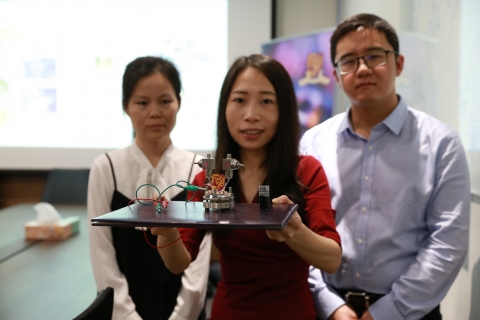
3D打印技術早已廣泛應用於科研、航空、機器、醫療等範疇,而中大研究團隊將相關技術進一步改善,研發全新「數碼全息納米3D打印機」(Nano-Builder),系統採用多焦點打印,突破傳統逐層打印模式,大大加快了速度與精準度,近日獲「創科界奧斯卡」之稱的「全球R&D 100年獎」嘉許,是本年度全球百大創新發明之一。團隊表示,有望將技術運用於納米級別的科研、醫療工具。

Date: 
Tuesday, December 18, 2018
Media: 
Wen Wei Po

港中大研發納米3D印表機 獲選全球百大創新發明

香港中文大學17日宣佈,由工程學院機械與自動化工程學系教授陳世祈及其團隊研發的“數碼全息納米3D印表機”,獲全球百大科技研發獎(R&D 100)評選為2018年度全球百大創新發明之一。該印表機採用革命性的數碼全息鐳射掃描及光束整形技術,能以高速印製結構複雜、細如髮絲的精細元件,並達至納米級別的列印精度。

Date: 
Tuesday, December 18, 2018
Media: 
People's Daily Overseas Edition

中大納米3D打印機助醫學研究

中大歷時四年研發「全息納米3D打印機」,不僅比傳統機打印速度快10至100倍,還能在空間中隨機掃描,更易操作。研發者陳世祈副教授稱,機器可打印微小至納米尺度的科研器件,還可用於顯微成像,有助醫學研究。該發明被全球R&D100年獎評為2018年度全球一百大創新發明之一。這一切歸功於數字全息雷射掃描及光束整形技術,新技術能以高速多焦點掃描需打印器件。

Date: 
Tuesday, December 18, 2018
Media: 
Ta Kung Pao

中大研納米3D打印機 秒速製生物支架

3D打印技術近年被廣泛應用於不同範疇,中大工程學院今年最新研發出「數碼全息納米3D打印機」(Nano-Builder),可秒速印製頭髮千分之一的微細物件,更突破傳統3D打印機的單點打印局限,新技術可任意多點印製,速度較傳統快最少10倍,並可應用於仿真生物支架等醫學用途,料最快今或明年可推出市場。

Date: 
Tuesday, December 18, 2018
Media: 
Sky Post

中大研納米3D打印機 秒速印製生物支架

3D打印技術近年被廣泛應用於不同範疇,中大工程學院研發「數碼全息納米3D打印機」(Nano-Builder),可秒速印製頭髮千分之一的微細物件,更突破傳統3D打印機的單點打印局限,可任意多點印製,速度較傳統快最少10倍,應用於仿真生物支架等醫學用途。中大工程學院機械與自動化工程學系教授陳世祈指,Nano-Builder採用革命性的數字全息雷射掃描及光束整形技術,以高速每秒2.2萬次多點掃描打印,突破傳統3D打印機單點、橫向逐層印製的技術限制。

Date: 
Tuesday, December 18, 2018
Media: 
Topick

中大研納米3D打印機 秒速印生物微支架

香港再有科研發明揚威國際!中文大學有團隊研發了「數碼全息納米3D打印機」(Nano-Builder),能以秒速印製結構複雜、細如髮絲的精細組件,更突破傳統3D打印機的單點打印局限,研究獲得有「創科界奧斯卡」之稱的全球R&D 100年獎嘉許,獲選為2018年度全球一百大創新發明之一。團隊指,該3D打印機作為基礎科研,有助研發高端納米科技和微支架等。

Date: 
Tuesday, December 18, 2018
Media: 
am730

Prof. Chen Shih-Chi Receives the 2018 R&D 100 Award for Developing the Digital Holography-based 3-D Nano-Builder for Ultrafast Micro-/Nano-Prototyping

Date: 
2018-12-18
Thumbnail: 
Body: 

Professor Shih-Chi Chen, Department of Mechanical and Automation Engineering and his team have been honoured with the globally prestigious 2018 R&D 100 Award – “The Oscar of Invention” for the development of the Digital Holography-based 3-D Nano-Builder. It can additively write micro-nano-scale components with complex structures in high speed and is especially suitable for applications in research and development such as printing photonic, robotic, metamaterials, micro-scaffolds, and drug delivery devices.

3-D printing technology has generated profound impact on the engineering world and is often considered the technology that drives the third industrial revolution. It covers a broad range of applications such as aviation, medicine, science and technology, and entertainment. 3-D printing has opened new possibilities for various industries by enabling faster and easier prototyping and manufacturing processes, but there are still a number of limitations in speed, resolution and flexibility. The Nano-Builder employs a revolutionary random-access scanning method that allows tens of laser foci to simultaneously write structures at 22.7 kHz. Compared with the existing point-scanning-based systems and solutions, the Nano-Builder presents distinctive advantages in precisely controlling the focus position, and each focal point can be independently controlled to follow any planned trajectory in space, which increases the throughput and reinforces the structure dramatically.

The focal point can be moved to any point in the work space at equal speed. Thus, complex overhanging structures can be printed without supporting structures/materials and the total fabrication time is only proportional to the solid volume of the structure, regardless of the level of complexity. In addition to the efficiency and accuracy, the printing resources can better be utilised, making the entire creation process of 3-D structures more cost-effective. Professor Chen believes the technology can best be applied in creating photonic, microfluidic, biomedical, or mechanical structures or devices and ultimately have impact on the world of manufacturing and micro-/nano-prototyping, accelerating discoveries in science and medicine.

Another distinctive advantage of the Nano-Builder is its modular design and extendibility. By replacing the CCD module with a photomultiplier tube (PMT) module, the Nano-Builder can be easily turned into a high performance two-photon excitation microscope with functions of simultaneous real-time imaging and multi-point optical stimulation—enabled by the holography-based ultrafast multi-focus laser scanner. In the system, femtosecond lasers can precisely stimulate the target cells with submicron precision without affecting the cells around the target, e.g. mouse brains or zebrafish, while simultaneously generating video-rate optical cross-sectional images in vivo.

The CUHK team received funding support from the Innovation and Technology Commission, including multiple tier 2 Innovation and Technology Funds (ITF), as well as the Technology Start-up Support Scheme for Universities (TSSSU) for developing the related laser scanning, imaging, and fabrication technologies over the past few years. The CUHK spin-off company, i.e., Precision Instrument and Optics Limited, from Professor Chen’s group was selected by the Pre-incubation Centre (Pi Centre) of CUHK where the team acquired good resources and support, including consultancies, training, workshops, and networking opportunities with potential investors and mentors.    

About R&D 100 Award

The R&D 100 Award was presented to the CUHK team in Orlando, Florida in November 2018. The Awards have long been considered the most globally prestigious recognition of inventions and innovations and are often regarded as the "Oscar of Invention". The R&D 100 Awards identify and celebrate the top technology products of the year around the world. The winners this year include teams from industry, academia and government institutes such as Leica, ANSYS, Inc., Texas Instruments, MIT, NASA and the US National Renewable Energy Laboratory (NREL). Many important technology breakthroughs that later became household names received the R&D 100 Awards, including the instant colour process film, Polaroid, (1963), the ink-jet printer (1967), the colour copier (1968), lithium batteries (1971), the automated teller machine, ATM, (1973), LCD, (1980), the personal supercomputer (1987), the lab HDTV (1998), and the artificial retina (2009).

Comparisons of 3D Printing Techniques

Key FeaturesCurrent Nanoscale 3-D Printer

CUHK Nano-Builder

Precision 3D printingYesYes
Curing mechanism2-photon absorption2-photon absorption
Coarse fabrication space100 × 100 × 3 mm3120 × 120 × 60 mm3
Fine fabrication space (with 40x objective)300 × 300 × 300 µm3206 × 103 × 524 µm3
Multi-foci printingNoYes
Printing processLayer-by-layerArbitrarily, programmable multi-point/ single-point writing
Printing point controlPizeo-positioner and galvo- scannerDMD scanner and motorised stage
Min. lateral step sizeContinuous scanning120 nm
Min. axial step sizeContinuous scanning270 nm
Voxel (lateral / axial)0.4 / 1.0 µm0.4 / 1.0 µm
Printing speed100 µm/s (PZT mode) 
10 mm/s (Galvo mode)
500 µm/s (single focus) 
5 mm/s (10 foci)
Focus control and wave-front correctionNoYes
Additional laser output portNoYes

*mm: millimeter, µm: micrometer, nm: nanometer


Filter: Dept: 
Faculty
MAE
Media Release

Engineering Professors Named Most Highly Cited Researchers

Date: 
2018-12-05
Thumbnail: 
Body: 

Prof. WONG Ching Ping, Emeritus Professor, Department of Electronic Engineering, and Prof. ZHAO Ni, Associate Professor, Department of Electronic Engineering have been named by Clarivate Analytics in the list of “Highly Cited Researchers 2018” as among the world’s top researchers whose work has been highly cited by fellow academics and are hence making a significant impact in ongoing research in their respective fields of study.

The Clarivate Analytics “Highly Cited Researchers 2018” identifies the most influential researchers as determined by their peers around the world. The honour is given to researchers who published a high number of papers that rank in the top 1% most-cited in their respective fields of study and year of publication. This year a new cross-field category has been added to recognise the researchers who are influential in different fields.

For the full list of “Highly Cited Researchers 2018”, please refer to: https://hcr.clarivate.com/


Filter: Dept: 
Faculty
EE

中大開設金融科技理學碩士課程 「職業導向」培訓人才

金融科技快展急速,對人才的需要大。為應對行業的發展趨勢,中文大學工程學院將繼本科課程後,將於2019至20年度,開辦金融科技理學碩士課程。
工程學院助理院長(教育)兼金融科技碩士學位課程主任李浩文表示,課程的目的是欲「職業導向」方式,為業界培訓「技術應用」或「商業應用」的人才,希望完成課程後的學生,可為業界提供更多發展新方向,甚至出來創業。
Date: 
Wednesday, November 21, 2018
Media: 
HK01

中大開辦金融科技理學碩士

近年科技為傳統金融服務業帶來影響,中文大學繼開辦金融科技本科課程後,明年將開辦金融科技理學碩士課程,課程內容包括金融基建、電子支付系統等內容;修讀的學生可自由選擇學習模式,包括課堂模式、實習模式及論文模式,以配合學生不同的興趣和發展方向。

Date: 
Thursday, November 22, 2018
Media: 
Sing Tao Daily

Pages