新科技教育普及 推動中學 AI 認知

人工智能(AI)並非深不可測,任何人都有能力借此數學分析工具,製作造福人群的應用。本地教學界今年在應付遙距學習之餘,也開始解放 AI 相關的教學資源與人才培訓。

香港教育城行政總監鄭弼亮認為,總結與分享過去一年在新冠肺炎下的教學經驗與主題,他指目前本地有多方面人才從事「教育新常態」的研究,同時透露教育城網站在過去大半年時間,在包括閱讀、評估與教師培訓的平台用量,最多達以往的 4 至 5 倍,甚至 10 倍水平,可見在疫情間網上服務密度明顯提升。


Date: 
Tuesday, December 8, 2020
Media: 
E-Zone

Professor Raymond Yeung Receives IEEE 2021 Richard W. Hamming Medal

Date: 
2020-12-07
Thumbnail: 
Body: 

Professor Yeung Wai-ho Raymond, Choh-Ming Li Professor of Information Engineering, and Co-Director of the Institute of Network Coding, The Chinese University of Hong Kong (CUHK), has been named the recipient of the IEEE 2021 Richard W. Hamming Medal for his fundamental contributions to information theory and pioneering network coding and its applications. This is one of the highest honours in electrical and electronics engineering. It is the first time this award has been won by an Asian researcher since its establishment in 1988. It is also the first time that home grown research in this area has been recognised at this level.  

Professor Raymond Yeung is a world-renowned expert in information theory and a co-founder of the field of network coding. In the early 1990s, he was invited to participate in a project of NASA’s Jet Propulsion Laboratory for salvaging the malfunctioning Galileo spacecraft. The 25-bit synchronization marker he designed was used for transmitting back to Earth the images of Jupitar and its satellites taken by the spacecraft. Since 2010, he has been a Co-Director of the Institute of Network Coding at CUHK, the largest engineering research project ever funded in Hong Kong, with the total budget exceeding HKD100M.

Information inequalities are an indispensable tool for proving theorems in information theory. For a long time, Shannon-type inequalities were all the known information inequalities. In the mid-1990s, Professor Yeung contemplated the existence of non-Shannon-type inequalities and discovered with his collaborator the first such inequality which is now known as the Zhang-Yeung inequality. This groundbreaking work proves the incompleteness of Shannon-type inequalities. In addition to information theory, this finding has significant implications in different fields in information sciences, mathematics, and physics.

Professor Yeung also co-founded the field of network coding. In the late-1990s, he proposed the concept of network coding that revolutionised network communication. In the past, information was transmitted in a network very much like commodity flow, with the intermediate nodes relaying data packets passively. Simply speaking, with network coding, by applying coding to data packets inside the network, more information can be transmitted through the network. In practice, this means people can download data faster, watch video streaming with less delay, and communicate more securely on the Internet.

Professor Yeung has co-founded n-hop technologies, a startup company in Hong Kong Science Park that focuses on BATS, a network coding technology that solves the longstanding problem of packet loss in wireless multi-hop communication. Currently they are applying this technology to provide WiFi service at country parks that are not well covered by the cellular network. With this service, hikers can use mobile devices for navigation, accessing weather information, uploading pictures to social media, and even emergency calls. Professor Yeung has also co-founded CU Coding, another startup company that focuses on network coding data storage and physical-layer network coding.

Professor Yeung is the author of two textbooks on information theory and network coding that have been adopted by over 100 universities around the world. The paper he co-authored that founded the field of network coding has received close to 10,000 citations on Google Scholar. In 2014, he offered the first online course in information theory that attracted 25,000 students. Since then, the course has been offered regularly on Coursera and other platforms.

Professor Yeung has received numerous awards for his research contributions, including the 2018 ACM SIGMOBILE Test-of-Time Paper Award and the 2016 IEEE Eric E. Sumner Award. He is a Fellow of the Hong Kong Institution of Engineers, the Hong Kong Academy of Engineering Sciences, and IEEE. He holds 10 patents on BATS codes.


About IEEE Richard W. Hamming Medal

IEEE Medals are the highest awards presented by the IEEE. The IEEE Richard W. Hamming Medal, established in 1986, is named in honor of Dr. Richard W. Hamming, who had a central role in the development of computer and computing science, and whose many significant contributions in the area of information science include his error-correcting codes. It is awarded to an individual or team for exceptional contributions to information sciences, systems, and technology.


Professor Yeung Wai-ho Raymond


Filter: Dept: 
Faculty
IE
Media Release

香港高校研究用人工智能科技助診斷阿茲海默症

香港中文大學(中大)的跨學科研究團隊3日公佈,近日獲資助約560萬港元展開阿兹海默症數碼生物標記的研發工作,透過尖端的傳感及人工智能技術,提升及早診斷阿茲海默症的效率及準確度。
全球人口老化問題嚴重,阿茲海默症和相關的認知障礙症患者亦隨之而增加。世界衛生組織統計顯示,全球有5千萬人患上認知障礙症,每年新增確診個案更高達1千萬。在香港,每10名年長人士便有一個罹患認知障礙症;到2036年,患者數目估計較2016年的11萬5千人,大幅增加兩倍多至約24萬人
Date: 
Friday, December 4, 2020
Media: 
中通社

中大與港大研發新法 檢測先天性巨結腸症致病基因

在香港,平均每3,500名新生嬰兒,便有一個患有「先天性巨結腸症」。患者從出生一刻開始就很少正常排便,患者通常有明顯腹部腫脹,他們需要進行外科手術切除腸道的「壞部分」,並重新連接消化系統的健康部分。即使進行了手術,部分患者仍然有腸道活動不足問題,甚至出現大便失禁和腸道感染。如果得不到適當治療,可導致死亡。

Date: 
Friday, December 4, 2020
Media: 
AM730

CUHK and HKU Jointly Develop MARVEL Data Analysis Method to Detect Pathogenic Genes of Hirschsprung’s Disease

Date: 
2020-12-03
Thumbnail: 
Body: 


Hirschsprung’s disease is one of the most common congenital diseases requiring an abdominal operation in the newborn period. Its strong heritability suggests that genetic factors play a key role in the development of the disease. To find out genetic variants that may cause the disease, researchers from CUHK and HKU jointly developed a novel data analysis method called MARVEL (Multiscale Analysis of Regulatory Variants on the Epigenomic Landscape). A scientific article describing the MARVEL method and the corresponding findings about Hirschsprung’s disease has recently been published in the journal Genome Research.
 
Most of us have experienced constipation before, which is caused by infrequent bowel movements. The situation can usually be improved within days by proper diet and physical exercise. A Hirschsprung patient has infrequent bowel movements starting from the day that he/she is born, and it can last his/her whole life if untreated, or even result in death. Typically characterised by a swollen belly, Hirschsprung patients need to go through a surgical operation to remove the “bad section” of the intestine and reconnect the healthy portions of the digestive system. Despite surgery, some patients continue to have infrequent bowel movements, or develop soiling and bowel infections. In Hong Kong, on average, there is a Hirschsprung case for every 3,500 newborns. 
Scientists have long known that many Hirschsprung patients have mutations around a gene called RET. This gene codes for a protein that is important for a type of cells involved in gut development and function. Mutating the gene is analogous to damaging the mould, which causes the products produced (the proteins) to be malfunctioning. There are also mutations that do not change the protein but instead alter the amount of it produced in the cells.
 
Notwithstanding, only less than a quarter of the Hirschsprung patients have RET mutations. For the remaining majority, the cause of the disease is expected to be more complex and involves other lesser known genes. Since there are millions of genetic variants in every person, and most of them have nothing to do with the disease, it is difficult to pinpoint the variants and the corresponding affected genes that are functionally related to the disease. To find out these genes systematically, a joint research project by CUHK and HKU was established in 2014. It required substantial collaboration among different professions: medical doctors collected samples; genome scientists deciphered the DNA; geneticists characterised DNA differences between patients and non-patients; computer scientists developed mathematical models to identify the most critical DNA differences; biologists experimentally tested the significance of these computational findings. 
MARVEL is one of the latest outcomes of the project. It is a computational data analysis method that has been used to discover many new genetic variants associated with Hirschsprung’s disease. Among its novelties, as compared to other methods, is its ability to consider the “convergent” effect of mutations; that the same functional impact can be produced by different mutations in different patients. 
 
Professor Kevin Yip, Associate Professor of the Department of Computer Science and Engineering at CUHK, said, “This project would not have been possible without the collaborative effort of people from diverse backgrounds. It is becoming a basic requirement for high impact biomedical projects.” 
 
Professor Yip is one of the three senior authors of the article in Genome Research. The other two are Professor Paul Tam and Professor Elly Ngan from the Department of Surgery at HKU. 
Professor Tam explained that the novel computational method is an important first step towards the application of precision medicine to this heterogeneous congenital disorder. In future, genome data will likely become routine in the medical care of Hirschsprung patients, and computation based genome analysis can aid in stratifying patients to receive “tailor -made” and more effective treatments. 
 
This project was funded by the Research Grants Council Theme-based Research Scheme (TRS). The project team will report its major research outcomes at the TRS Public Symposium on December 13th. Information about this symposium can be found at  https://www.ugc.edu.hk/eng/rgc/about/events/symposium/symposium20.html 
 
This article was originally published on CUHK Communications and Public Relations Office website.


Filter: Dept: 
Faculty
CSE
Media Release

CUHK Receives Research Funding on Advancing Digital Biomarkers for Alzheimer's Disease

Date: 
2020-12-03
Thumbnail: 
Body: 

A multi-disciplinary team of researchers from CUHK has been granted up to 5.6 million Hong Kong dollars to assist in developing machine learning technologies for advancing digital biomarkers for Alzheimer’s Disease. This will contribute to the efficiency and accuracy of early identification using the state-of-the-art sensing and artificial intelligent (AI) technologies. The project is funded by the Diagnostics Accelerator program of Alzheimer’s Drug Discovery Foundation (ADDF) and a matching fund from SenseTime Technologies (SenseTime). It is led by Professor Guoliang XING from the Department of Information Engineering, Faculty of Engineering at CUHK, joined by local engineering and medical experts.

Alzheimer's Disease (AD) and related dementia is a growing health problem worldwide because of population aging. It affects 50 million people and there are more than 10 million new cases worldwide. It has been one of the most common chronic diseases for the aging population in Hong Kong, affecting one in every ten older adults. The number of confirmed cases is expected to rise from 115,000 in 2016 to around 240,000 cases in 2036.

Early identification of people at risk of developing AD and timely intervention to slow the onset and progression of AD are crucial, because disease modifying treatment for AD is not available at present. An accurate, easy-to-do test may enhance the effectiveness of screening and identification of AD and address the problem of denial of the illness. 

Recent years have witnessed significant progress in the Internet of Things (IoT) and smart sensing technologies, with many advanced sophisticated sensors making their way into personal and mobile devices. Many families today own more than a dozen  connected smart devices.  These devices can capture, on an unprecedented scale, the physiological, behavioral, lifestyle, and cognitive indicators, referred to as “digital biomarkers”, in natural living environments in a non-invasive manner.

Professor Bolei ZHOU from the Department of Information Engineering, CUHK, and a member of the research team, stated, “Machine learning technique allows us to conduct objective longitudinal monitoring and comparison of indicators, enabling the detection of minimal abnormalities in our nervous system, thus achieving early identification of and intervention in AD. However, the prevalence of sensors will lead to various issues such as privacy concerns and the “black box” nature of AI algorithms. These must be solved in order to interpret the digital markers and their links with disease pathophysiology.”

Comprising experts in AI and various medical specialties, the multi-disciplinary team aims to develop cutting-edge sensing and AI technologies to discover new digital biomarkers for early diagnosis of Alzheimer’s Disease.  The developed technologies will classify digital biomarkers for Activities of Daily Living (ADL), Behavioral and Psychological Symptoms of Dementia (BPSD), social interactions, motor function, and level of cognition. The team will also develop a real-time learning system which enables smart devices to collaboratively improve the accuracy of AI algorithms while keeping all the data on the device and hence preserving user privacy. In addition, the team will also propose interpretable machine learning algorithms to quantify the correlation of multi-modal digital biomarkers, and assist early detection, diagnosis and intervention. 

The new technologies from this project will lead to new approaches that can detect any immediate risks that require prompt attention or action. They will predict and identify individuals who have a higher chance of developing AD and dementia, introduce appropriate advice based on the specific needs of the individual, modify that according to the response of the prior suggestion or intervention, and provide feedback to the patients and caregivers so as to improve self-care management of the disease and stress adaptation. 

Professor Guoliang XING, the Principal Investigator (PI) of this project, stated, “This project will bring together top experts from engineering and medical fields to address one of the biggest challenges faced by our aging society. The sensing and AI technologies to be developed will empower doctors, caregivers and patients themselves to work together for early diagnosis of and intervention in AD. We believe this project will lead to important enabling technologies for the paradigm of “smart health”, the  vision of which is to transform today’s reactive hospital centred healthcare practice to proactive, individualised care and wellbeing.” 

Background of the project and research team

The project team includes Professor Guoliang XING as Principal Investigator (PI), and 5 Co-PIs: AI experts Professors Bolei ZHOU and Rosanna CHAN from the Department of Information Engineering, Professor Timothy KWOK from the Department of Medicine and Therapeutics, Dr. Allen LEE from the Department of Psychiatry, Faculty of Medicine at CUHK, and Professor Doris YU from the School of Nursing at the University of Hong Kong.

The major funding comes from the ADDF’s Diagnostics Accelerator, an initiative dedicated to developing reliable and affordable biomarker test for early diagnosis of Alzheimer’s disease. The ADDF was founded in 1998 and has awarded more than $150 million to fund over 626 programs for Alzheimer’s and related dementias in academic centers and biotechnology companies in 19 countries. To learn more, visit: www.alzdiscovery.org/ .


Filter: Dept: 
Faculty
IE
Media Release

中學生研發App及早識別學前讀寫障礙 下月參展創新科技嘉年華

本港中小學近年開始推行STEM教育,鼓勵及訓練學生實踐科學、數學等知識,研發新技術。有中學生就因為身邊同學有讀寫障礙,了解到本港讀寫障礙學童往往較遲被發現,錯失治療良機,因而研發能識別學前讀寫障礙兒童的應用程式及玩具,讓家長及學校可參考測試結果,及早求醫。

Date: 
Monday, November 30, 2020
Media: 
HK01

楊潤雄:香港擁世界級科研能力、全國最國際化 盼培訓創科人材

港府近年致力推行STEM教育,中文大學獲賽馬會捐助,推行為期三年的「智」為未來計劃,希望培訓學生在人工智能(AI)的知識,計劃開展約一年後,今日(28日)舉行典禮回顧成果。教育局局長楊潤雄以預錄影片為活動致辭時,形容香港是全中國最國際化的城市,擁有世界級的科研能力、健全司法、知識產權保護制度及國際化營商環境,有信心可匯聚大灣區和全球創新資源,鼓勵年輕新一代學習創新科技,並加入創科行列。

Date: 
Monday, November 30, 2020
Media: 
HK01

中大賽馬會「智」為未來計劃 培育新一代數碼精英 AI 中大 人工智能 工程學院 教育學院 賽馬會

中大賽馬會「智」為未來計劃首席負責人任揚教授(中)、計劃副負責人暨評估及分析小組主領蔡敬新教授(右二)、網上學習平台小組主領金國慶教授(左一)及課程發展小組主領黃蔚皓教授(右一)合照。
隨著運算、通信及傳感技術急速發展,人工智能(AI)的應用日趨普及化。為協助年輕一代就數碼化未來作好準備,香港中文大學(中大)工程學院及教育學院獲香港賽馬會慈善信託基金捐助,於2019年開展中大賽馬會「智」為未來計劃 (下稱「計劃」) ,協助初中學生掌握AI知識。計劃今天(11月28日)舉辦「中學智能創意比賽2020」頒獎典禮,並公布該計劃一年來的成果及介紹未來的活動,共有超過150名中學校長、教師、學生和家長參與,反應熱烈。
Date: 
Monday, November 30, 2020
Media: 
MingPao

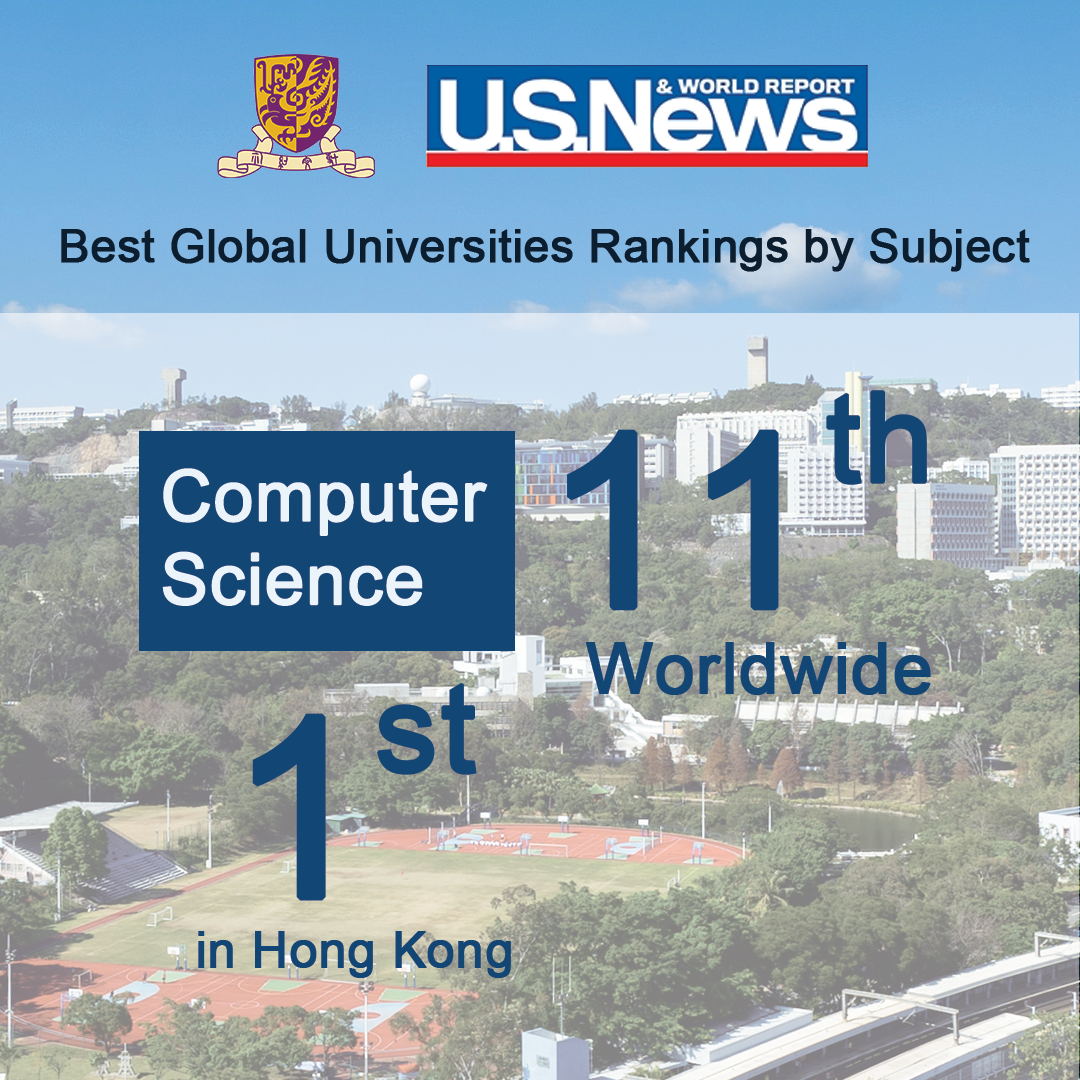
CUHK Computer Science Ranks No. 11 Worldwide and No. 1 in Hong Kong in U.S. News and World Report 2021

Date: 
2020-11-26
Thumbnail: 
Body: 
CUHK is ranked No. 11 worldwide and No. 1 in Hong Kong in Computer Science in the Best Global Universities Rankings recently announced by U.S. News & World Report 2021. 
 
The Best Global Universities Ranking by U.S. News & World Report covers a total of 38 subject rankings and evaluated nearly 1,500 top universities across 86 countries using over 10 research performance indicators, namely number of publications and books, total number of citations, global and regional research reputation, and international collaboration. Across all the ranking indicators and weights, CUHK is listed No.11 globally and No.1 in Hong Kong with an outstanding score of 84 in Computer Science.
 
“We are very pleased with our latest global ranking as one of the best universities for computer science as it demonstrates that our research strength and impact are widely recognised and comparable with the world’s other top universities. The Faculty of Engineering’s excellent performance in both teaching and research is dependent on the support and collaborative efforts of our colleagues. We will persist in pushing technological boundaries, cultivating more outstanding talent, and maintaining our leading academic position as we go forward,” said Professor Martin D. F. Wong, Dean of the Faculty of Engineering, CUHK.
 
Over the years, CUHK has achieved a number of significant scientific research breakthroughs in the field of computer science. Members of the Faculty of Engineering have demonstrated a proven track record of top-tier publications at internationally renowned academic conferences, and given a remarkable performance in the General Research Fund Programme and Early Career Scheme under the Hong Kong Research Grants Council. The Faculty is also committed to advancing applied research in artificial intelligence (AI) and machine learning, while fostering collaboration with world renowned universities and institutions like Massachusetts Institute of Technology, the University of Illinois at Urbana-Champaign, Stanford University, the University of California, Berkeley, Georgia Institute of Technology, and Tsinghua University. In addition, a total of 11 faculty members were recently placed on the AI 2000 Most Influential Scholar Annual List jointly released by Tsinghua-Chinese Academy of Engineering’s Joint Research Center for Knowledge and Intelligence, and the Institute for Artificial Intelligence of Tsinghua University. They are from different Engineering departments, including Computer Science and Engineering, Electronic Engineering, Information Engineering, and Systems Engineering and Engineering Management, earning international acclaim for their research excellence. 


Filter: Dept: 
Faculty
CSE
EE
IE
SEEM
Media Release

Pages